
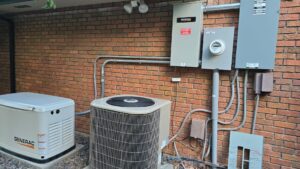
What is a whole house generator? A whole house generator is a permanently installed standby power system that starts automatically when utility power fails. It connects to your home electrical panel through an automatic transfer switch and runs on natural gas or propane, restoring power within seconds and running continuously until the grid comes back.
Colorado puts more stress on the grid than most states. High wind events roll across the Front Range every spring and fall, heavy spring snow loads snap distribution lines, and summer storms take out neighborhood circuits without warning. When the power stops, so does your heat, your well pump, your sump pump, your refrigerator, and your internet.
The Generator CO connects Colorado homeowners with certified Generac installers for whole house generator installation, repair, and maintenance across Denver metro, Colorado Springs, and the wider Front Range. This guide covers how these systems work, how Colorado altitude changes the sizing math, what permitting looks like county by county, and what to expect on installation day.
Whole House, Whole Home, Standby, Backup: All the Same System
The terminology causes real confusion, so it is worth clearing up before anything else.
A whole house generator, a whole home generator, a standby generator, and a home backup generator all describe the same equipment. Manufacturers, installers, and homeowners use the four terms interchangeably. Every one of them refers to a permanently mounted unit that sits outside on a pad, ties into your gas line and your electrical panel, and switches on by itself.
None of those terms describe a portable generator. That distinction matters more than the naming, and the section below covers it.
How a Whole House Generator Works
A standby system has four parts working together.
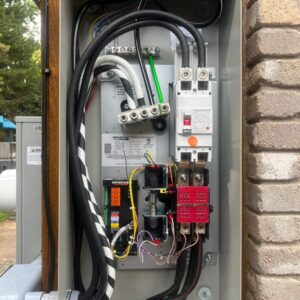
The generator itself sits outside on a level pad, typically in an enclosure rated for weather and sound. The automatic transfer switch sits next to your electrical panel and constantly monitors utility voltage. The fuel supply comes from a utility natural gas line or an onsite propane tank. The control board manages startup, shutdown, and the weekly self test.
When utility voltage drops, the transfer switch senses the loss and signals the generator to start. The engine spins up and stabilizes, usually in five to fifteen seconds. The transfer switch then physically disconnects your home from the utility and connects it to the generator. That physical separation matters for safety, because it prevents backfeed onto the utility lines where line crews are working.
When utility power returns and holds steady, the switch transfers the house back, and the generator runs a short cooldown before shutting off. The entire cycle happens without anyone at home.
Why Colorado Homes Need Standby Power
Wind Events on the Front Range
Downslope windstorms regularly hit the Front Range corridor with gusts strong enough to bring down trees and distribution lines across Boulder, Jefferson, and Douglas counties. These events knock out power to tens of thousands of homes at a time, and restoration in foothill neighborhoods can stretch past a day.
Heavy Wet Snow
Colorado spring snow carries far more water weight than midwinter powder. That weight accumulates on limbs and conductors, and the resulting line failures cluster in exactly the established, tree-lined neighborhoods where many Denver metro homes sit.
Freeze Risk
An extended winter outage puts your plumbing at risk. Once the heat stops, interior temperatures in an unoccupied Colorado home fall fast, and burst supply lines cause damage that dwarfs the cost of backup power.
Rural Well and Septic Systems
Homes in Elbert County, unincorporated Douglas County, Garfield County, and the plains east of Aurora often run on well water and septic. No power means no water pressure and no septic pump. A standby generator is closer to a necessity than a convenience for these properties.
Natural Gas Generator Installation in Colorado
What is a natural gas generator? A natural gas generator is a standby unit fueled directly from your utility gas line rather than from a stored tank. It is the most common configuration across Denver metro and Colorado Springs because the gas infrastructure is already at the house.
The advantage is simple. There is no tank to fill, no fuel to stabilize, and no run time limit. As long as the gas line holds pressure, the generator runs.
The one item that catches homeowners by surprise is meter capacity. Your existing gas meter and service line were sized for your furnace, water heater, range, and dryer. Adding a standby generator adds a significant load, and the meter sometimes needs an upgrade before the system can be commissioned. A qualified installer verifies this during the site assessment and coordinates the utility upgrade when one is required. Discovering it after the equipment arrives is what turns a two week project into a six week project.
Propane remains the right answer for homes without a gas main, which describes much of Garfield County and the rural stretches of El Paso and Elbert counties. Propane burns clean, stores indefinitely without degrading, and works well in cold weather. It does require tank sizing that matches your expected outage duration, plus a delivery relationship with a local supplier.
Portable Versus Standby Generators
| Factor | Portable Generator | Standby Generator |
|---|---|---|
| Startup | Manual, requires someone at home | Automatic, within seconds |
| Coverage | A few circuits or extension cords | Whole home or selected essential circuits |
| Fuel | Gasoline, refilled by hand | Natural gas or propane, continuous |
| Run time | Limited by tank size | Effectively unlimited on natural gas |
| Safety | Carbon monoxide and backfeed risk if misused | Permitted, inspected, transfer switch isolated |
| Winter usability | Requires going outside in the storm | Runs untouched through the storm |
For a Colorado winter outage, the practical difference is stark. A portable generator requires someone to be home, awake, and willing to go outside in weather to start it and refuel it every several hours. A standby unit handles the outage whether you are asleep, at work, or out of state.
What Size Whole House Generator Do You Need?
Sizing depends on connected load, not square footage alone. Square footage is a starting estimate that a real load calculation then corrects.
| Capacity | What It Typically Covers | Common Fit |
|---|---|---|
| 7.5 to 10 kW | Lights, refrigerator, furnace fan, sump pump, outlets | Essential circuits only, smaller homes |
| 14 to 18 kW | Essentials plus water heater and one air conditioning unit | Many 1,500 to 2,000 square foot homes |
| 20 to 24 kW | Full home coverage including major systems | The most common Front Range residential size |
| 26 to 32 kW | Larger homes with multiple HVAC compressors | Large homes, well and septic properties |
| 36 to 48 kW | Estates and light commercial applications | Acreage properties, small commercial buildings |
As a general guide, a 1,500 square foot Colorado home usually lands in the 15 to 20 kW range and a 2,500 square foot home usually lands in the 20 to 25 kW range. Homes with two air conditioning compressors, electric heat, a well pump, a hot tub, or an EV charger need an actual load calculation. So does any home in the mountains, for the reason covered next.
For a deeper walkthrough, see our guide on what size generator your home needs.
Altitude Changes the Sizing Math in Colorado
This is the factor most out of state sizing calculators miss, and it is the single most Colorado specific thing about installing a generator here.
Naturally aspirated engines lose roughly three percent of rated output for every 1,000 feet of elevation above sea level. Thinner air carries less oxygen, so the engine produces less power from the same displacement.
Run that math against Colorado elevations. Denver sits near 5,280 feet. Colorado Springs sits near 6,035 feet. Evergreen, Conifer, and Bailey sit higher still. A generator rated at a given output at sea level delivers noticeably less than that rating at Front Range elevation, and less again in the foothills.
The practical consequence is that a unit sized correctly for a comparable home in Kansas can fall short at a Colorado address. Proper sizing here starts from the derated output at your specific elevation, not the number on the spec sheet. Ask any installer you are considering how they account for altitude. The answer tells you a great deal about whether they work in this market regularly.
The Whole House Generator Installation Process
1. Load Assessment and Sizing
An installer inventories your electrical loads, reviews your panel capacity, notes your elevation, and determines whether you want whole home coverage or a managed essential circuit approach. This step produces the equipment specification.
2. Site Selection
Placement has to satisfy manufacturer listing, local code, and often an HOA. Typical requirements include 18 inches of clearance from the structure on the equipment side, 36 inches in front for service access, and at least 60 inches of separation from any operable window, door, or fresh air intake. Proximity to both the gas meter and the electrical panel keeps the run lengths and the cost reasonable.
3. Permitting
Every Colorado jurisdiction requires an electrical permit, and nearly all require a separate mechanical or gas permit. This is usually the longest phase of the project. The next section breaks down what to expect by county.
4. Foundation and Set
A level base goes in, either a poured concrete pad or a compacted gravel bed with a composite pad. The base keeps the unit out of standing water and snowmelt, which matters more here than in drier climates.
5. Electrical and Fuel Connection
The transfer switch is mounted and tied into the panel. The gas line is run and pressure tested, or the propane tank is set and connected. Grounding is verified.
6. Commissioning, Inspection, and Handover
The system is started, the governor and voltage regulation are checked, and a load test confirms the unit actually carries the house rather than simply running. The jurisdiction inspects. You get a walkthrough covering the weekly self test schedule, the maintenance interval, and what the status codes mean.
Expect one to two days of on site work. Expect two to six weeks start to finish, with permit turnaround and utility scheduling driving nearly all of the variance.
Colorado Permits and Inspections by County
Permit requirements are not uniform across the state, and the differences affect your timeline more than any other factor. Below is what generally applies across the areas we cover.
| Jurisdiction | Typical Requirements |
|---|---|
| Denver | City electrical and mechanical permits, plan review for larger units, zoning setback verification |
| Aurora | City permits through Building Division, setback and noise ordinance review, spans Arapahoe, Adams, and Douglas counties |
| Arapahoe County | County electrical and mechanical permits for unincorporated areas, municipal permits inside city limits |
| Adams County | County permits for unincorporated areas, separate processes in Thornton, Westminster, Brighton, and Commerce City |
| Douglas County | County permits for unincorporated areas, separate review in Parker, Castle Rock, and Lone Tree, frequent HOA placement approval |
| Jefferson County | County permits, additional wildfire mitigation and defensible space considerations in foothill zones |
| El Paso County | Regional Building Department handles Colorado Springs and most surrounding jurisdictions under one process |
| Pueblo County | City of Pueblo and county each run separate permitting, propane common outside the city |
| Garfield County | County permits, propane standard in most areas, longer travel and inspection scheduling windows |
The Generator CO handles permit applications and inspection scheduling as part of every installation. Requirements do change, so treat the table above as orientation rather than a substitute for a current jurisdiction check.
Where We Install Whole House Generators in Colorado
The Generator CO coordinates whole home generator installation across the Front Range and into western Colorado. Select your area for local details.
Whole home generator installation across Aurora, including 80010, 80011, 80012, 80013, 80014, 80015, 80016, 80017, 80018, and 80019. Aurora spans three counties, so permitting depends on your specific address.
Standby generator installation throughout Colorado Springs, including 80909 and the surrounding neighborhoods. Elevation near 6,035 feet makes altitude derating a required part of sizing here.
Home backup generator installation across Denver, from Park Hill and Washington Park to Green Valley Ranch. Tight lot lines make placement and setback review the critical early step.
Home standby generators for Englewood and neighboring Cherry Hills Village and Sheridan. Older housing stock here often needs panel evaluation alongside the generator specification.
Whole house generator installation in Parker and across Douglas County. HOA placement approval is common here and is worth starting early in the process.
Home backup generator installation across Adams County, including Thornton, Westminster, Brighton, and Commerce City. Each municipality runs its own permitting process.
Backup generator installation throughout El Paso County, including Monument, Falcon, Fountain, and Peyton. Pikes Peak Regional Building Department consolidates most permitting.
Whole house generator installation in Pueblo and Pueblo County. Propane systems are common outside city gas service areas.
Standby generator installation in Glenwood Springs and Garfield County. Mountain elevation and propane fuel drive most sizing decisions in this region.
Whole home generator installation across Littleton, Highlands Ranch, and Ken Caryl. Mature tree cover makes these neighborhoods outage prone during wet snow events.
Home standby generators for Castle Rock, Franktown, and Larkspur. Wind exposure along the Palmer Divide makes this a high demand corridor for backup power.
Whole house generator installation across Jefferson County. Foothill properties require wildfire mitigation clearance in addition to standard setbacks.
Maintenance After Installation
A standby generator that has not been serviced is a standby generator that may not start. Colorado conditions accelerate the usual wear. Blowing dust from the eastern plains loads air filters faster than in most regions, freeze and thaw cycling stresses connections, and windblown snow finds its way into enclosures.
Manufacturers specify annual service at minimum, with oil and filter intervals set by accumulated run hours. A proper annual visit covers oil and filter, air filter, spark plugs on the interval, battery load test, coolant on liquid cooled units, transfer switch inspection, and a full load test.
That last item separates a real service visit from a cursory one. A generator can start, idle, and sound healthy while still being unable to carry your house. Only a load test proves it will perform when the outage arrives. Ask specifically whether a load test is included.
Is a Whole House Generator Worth It in Colorado?
For most Front Range homeowners the answer depends on three questions.
How often does your address actually lose power? Outage frequency varies enormously by neighborhood. Foothill and tree lined areas lose power far more often than newer developments with buried utilities.
What breaks when the power stops? A well pump, a sump pump, a septic pump, medical equipment, a home office, or a finished basement below the water table all raise the stakes considerably.
How long could you be out? A two hour outage is an inconvenience. A two day outage in January is a burst pipe risk and a hotel bill.
Homes with well water, medical dependencies, or a history of multi day outages tend to see the clearest return. Standby generators also register with buyers as a meaningful upgrade in Colorado markets where outages are a known local issue.
Frequently Asked Questions
What is a whole house generator?
A whole house generator is a permanently installed standby power system that starts automatically when utility power fails. It connects to your electrical panel through an automatic transfer switch and runs on natural gas or propane, restoring power within seconds and running until the grid returns.
Is a whole house generator the same as a whole home generator?
Yes. Whole house generator, whole home generator, standby generator, and home backup generator all describe the same equipment. The terms are used interchangeably and all refer to a permanently mounted automatic system rather than a portable unit.
How long does whole house generator installation take in Colorado?
Most Colorado installations take one to two days of on site work once permits are approved. The full timeline from signed proposal to final inspection typically runs two to six weeks, driven mainly by county permit turnaround and gas utility scheduling.
Do I need a permit to install a whole house generator in Colorado?
Yes. Every Colorado jurisdiction requires an electrical permit, and most require a separate mechanical or gas permit for the fuel connection. El Paso County, Adams County, Arapahoe County, Douglas County, and Garfield County each run their own review process. The Generator CO handles permitting and inspection scheduling for every installation.
Does Colorado altitude affect generator performance?
Yes. Naturally aspirated engines lose roughly three percent of rated output per 1,000 feet of elevation because thinner air carries less oxygen. At Denver elevation near 5,280 feet and Colorado Springs elevation near 6,035 feet, the reduction is significant. Correct Colorado sizing starts from derated output, which is why a unit sized for a sea level home can fall short here.
What size whole house generator do I need for a Colorado home?
Sizing depends on total connected load rather than square footage alone. As a general guide, a 1,500 square foot home usually needs 15 to 20 kW and a 2,500 square foot home usually needs 20 to 25 kW, with altitude derating added. Homes with multiple air conditioning compressors, electric heat, well pumps, or EV chargers need a full load calculation.
Can a whole house generator run on natural gas in Colorado?
Yes, and natural gas is the most common choice across the Front Range because most homes already have a utility gas line. A natural gas generator never needs refueling. Installation requires verifying that the existing meter and service line can carry the added load, and an upgraded meter is sometimes needed.
How far from the house does a standby generator need to be?
Clearances follow the manufacturer listing and local code. Common requirements are 18 inches from the structure on the equipment side, 36 inches in front for service access, and at least 60 inches from any operable window, door, or fresh air intake. Local setbacks and HOA rules can tighten these further.
Do you install whole house generators in Aurora and Colorado Springs?
Yes. The Generator CO covers Aurora, including the 80010 through 80019 zip codes, and Colorado Springs, including 80909 and the surrounding El Paso County communities. Coverage also includes Denver, Englewood, Littleton, Parker, Castle Rock, Highlands Ranch, Adams County, Pueblo, and Glenwood Springs.
How often does a whole house generator need maintenance?
Manufacturers specify annual service at minimum, with oil and filter changes based on run hours. Colorado dust, temperature swings, and snow intrusion accelerate wear. An annual inspection that includes a load test confirms the unit will carry the house during the next outage rather than simply starting.
Get a Free Whole House Generator Quote in Colorado
The Generator CO works with certified Generac installers across Denver metro, Colorado Springs, and the Front Range. Every quote starts with a load assessment, an elevation adjusted sizing recommendation, and a written scope that covers permitting and inspection.
Request your free estimate or call (720) 295-7915 to schedule a site assessment.
October 30, 2025